

Finland
Discover the land of a thousand lakes and the northern lights, where Arctic nature merges with modern design in a peaceful atmosphere.
Quick Facts
- Capital
- Helsinki
- Language
- Finnish
- Swedish, Sami
- Currency
- Euro (EUR)
- Best time to visit
- From June to August for the weather or from December to March for snow and auroras.
- Budget per day
- $80 - $250 per day
- Climate
- Temperate continental climate in the south and subarctic in the north, with very cold winters and mild, bright summers.
- Connectivity
- good
- Very easy to obtain through prepaid cards in convenience stores or via eSIM.
- Electricity
- Type C / F (230V)
- Local transport
- good
- Card usage
- very widespread
- Tipping
- no
🌎 Introduction
In Northern Europe, where the forest merges with thousands of lakes, lies a territory that breathes to the rhythm of its seasons. Far from the rush, life here unfolds between the relentless light of summer and the quiet silence of the snowy months. It is a corner of the world where nature is not something observed from a distance, but a constant presence that shapes the character of its people and the design of its cities.
That same simplicity is reflected in everyday traditions, from the comforting ritual of the sauna to the taste for the honest flavors of the forest and the sea. Finnish culture invites you to stop and notice the details: the aroma of a freshly baked cardamom bun, the functionality of a well-designed object, or the calm of a walk through the archipelago. Among its landscapes, one can discern an identity that naturally balances urban avant-garde with a deep respect for the legacy of the land.
🛡️ General Safety
Finland is internationally recognized as one of the most safe and stable destinations in the world. For the traveler, this translates into an atmosphere of tranquility that allows for enjoying its landscapes and cities with a minimal level of concern compared to other global destinations.
General safety level
- The overall safety rating in Finland is very high. It consistently ranks among the top positions in peace and citizen safety indices.
- Compared to the international average, the risk of serious incidents is very low. The country is characterized by a strong social contract, low levels of corruption, and high trust in public institutions.
- For the traveler, the context is one of maximum normality. It is common to see children moving alone through cities or unattended belongings in public places (although the latter is not recommended), reflecting the prevailing civility in Finnish society.
Crime and common risks
- The most common type of crime that can affect tourists is petty theft, such as pickpocketing or phone theft. These usually occur mainly in the summer months when there are larger crowds.
- It is recommended to take extra precautions at the Helsinki Central Railway Station and in the nightlife areas of large cities during early morning hours on weekends.
- Scams targeting tourists are very rare, but it is advisable to be wary of unofficial transport offers or accommodations that do not use recognized booking platforms.
- A rarely mentioned but real risk is bicycle theft, although this affects residents more than short-term tourists.
Safety in cities and tourist areas
- The urban centers of cities like Helsinki, Tampere, or Turku are extremely safe, even at night. Public lighting is excellent, which is vital given the lack of sunlight during winter months.
- Public transport (metro, tram, trains, and buses) maintains exceptional levels of safety and cleanliness. There are no “no-go” zones or marginal neighborhoods that tourists should avoid due to physical integrity risks.
- As a practical recommendation, simply applying common sense is enough: keep backpacks closed in crowded places and do not leave valuables in sight in rental vehicles.
Transport safety
- The public transport system is punctual, efficient, and very safe. Personal safety incidents on transport are rare.
- Regarding driving, in Finland, traffic moves on the right. The condition of the roads is excellent, although conditions change drastically in winter.
- The use of winter tires is mandatory during cold months. The greatest road risk in rural areas is collisions with wildlife, specifically reindeer in the north and moose in the rest of the country. These animals are especially active at dawn and dusk.
- The use of taxis is safe, but it is recommended to use official applications or marked stands to avoid excessive rates, although fraud is minimal.
Natural and climatic risks
- Finland does not suffer from risks of natural disasters such as earthquakes, hurricanes, or severe flooding. The main challenge for the traveler is the extreme climate.
- During winter, temperatures can drop below -20°C or -30°C, especially in Lapland. The risk of frostbite and hypothermia is real if proper clothing (thermal layers) is not used.
- Sidewalks and roads can become extremely slippery due to black ice or compacted snow. Falls are the most common cause of injury among tourists in winter.
- In summer, although the weather is mild, the main risk is disorientation in forested areas if hiking without preparation, in addition to the massive presence of mosquitoes in certain northern areas.
Local legislation and norms
- Finland has very strict laws regarding drinking and driving. The blood alcohol limit is very low, and fines are proportional to the offender’s income, which can result in very high figures.
- The sale of high-proof alcohol is centralized in state-owned stores called Alko. Supermarkets only sell beverages with low alcohol content.
- Respect for pedestrian traffic rules is high; crossing on a red light for pedestrians is usually frowned upon and can be fined.
- There is the “Everyman’s Right” (Jokamiehenoikeus), which allows walking and collecting berries or mushrooms freely in nature, provided private property is respected and no litter is left behind.
Safety for specific groups
- Solo female travelers: Finland is one of the safest countries for women traveling alone. Street harassment is practically non-existent, and gender equality levels are among the highest in the world.
- LGTBIQ+ travelers: The country is very progressive and respectful. Helsinki has an active scene, and no specific safety problems are reported for this group.
- Children and the elderly: Infrastructures are fully adapted. It is an ideal destination for families due to environmental safety and the quality of health services and accessibility.
Emergencies and assistance
- The universal emergency number is 112. Police, ambulances, and firefighters are coordinated from this number. The service is multilingual and very efficient.
- The Finnish police are highly professional, friendly, and usually speak excellent English. If you need assistance, you can approach them with total confidence.
- In case medical assistance is required, Finnish hospitals offer very high standards of care. It is always recommended to travel with health insurance or the European Health Insurance Card (for EU citizens).
Tip: If traveling in winter, always use a safety reflector (pieni heijastin) hanging from your jacket or backpack; it is a small reflective object very common in Finland that helps drivers see you in total darkness, preventing accidents.
📝 Entry Requirements
To plan a trip to Finland, the first fundamental step is to have a valid passport. It is generally recommended that this document has a minimum validity of at least three to six months beyond the planned date of departure from the territory. The physical integrity of the document is essential, so it must be in good condition to facilitate identification at border control points.
The need to process a tourist visa varies according to the traveler’s origin and current international agreements. In many cases, entry for recreational purposes is allowed without a prior visa for short stays, which are usually limited to a maximum of 90 days within a 180-day period. It is advisable to verify your specific situation before starting the journey to ensure that you comply with the required access permits according to your visitor profile.
During the entry process, border personnel may request additional documentation to support the reason for the trip. It is common to be asked to show a return ticket or a ticket to a third country, as well as proof that sufficient financial resources are available to cover the planned stay and travel. It is also helpful to have a confirmed accommodation reservation or information about the planned itinerary.
Regarding customs regulations, there are limits for the introduction of certain items such as alcohol and tobacco, which must be intended exclusively for personal consumption. If traveling with medication, it is highly recommended to carry the corresponding medical prescription. Likewise, the entry of products of animal origin, such as meat or dairy, is usually subject to restrictions to prevent health risks and protect the local ecosystem.
From a health point of view, there are usually no mandatory vaccines for tourists visiting the country. However, it is advised to keep the basic vaccination schedule generally applied up to date. Having travel insurance that includes broad medical coverage is a suggested practice to manage any health assistance needs that may arise during the visit with peace of mind.
Controls at airports and other access points are usually smooth and oriented towards ensuring the safety of all travelers. It is important to follow the instructions of the officers and be prepared for a possible inspection of hand and checked luggage. Declaring goods that exceed the permitted limits avoids unnecessary complications when entering the country.
- Necessary documentation: Valid passport with a recommended validity of several months after the departure date.
- Stay permits: Tourist visa for certain origins or exemption for visits of less than three months.
- Stay period: Usual limit of ninety days for tourist or personal activities.
- Justification of means: Possibility of requiring proof of financial funds and exit transport ticket.
- Customs regulations: Limitations on the import of tobacco, alcoholic beverages, and certain fresh foods.
- Health and well-being: Absence of mandatory vaccines for entry, with the recommendation of taking out private medical insurance.
- Personal items: Need to present medical prescriptions for the transport of specific or chronic-use medication.
🏥 Basic Health Considerations
On your trip to Finland, you will find one of the most advanced and efficient health systems in the world. Medical care is of excellent quality in both public and private centers. If you are a citizen of the European Union, you can use your European Health Insurance Card to access public healthcare, although you will have to pay the small co-payment fees that residents also pay. If you come from outside the EU, the usual practice is to go to private clinics where care is very fast. A point very much in your favor is that the vast majority of medical staff speak English fluently, so it will be very easy for you to explain what is wrong.
Taking out travel medical insurance is not a mandatory requirement to enter the country as a tourist, but it is highly recommended. It is advisable that your policy includes broad coverage for hospitalization, medical transfers, and repatriation. Although public healthcare is accessible, costs in the private sector for a tourist can be high if a serious unforeseen event arises, and having insurance will save you from any economic concern.
Regarding vaccines, there are none that are mandatory to enter Finnish territory. All you need is to have your usual vaccination schedule up to date. If you plan to do many outdoor activities, hiking, or camping in forested areas during the summer months, you might consider the vaccine against tick-borne encephalitis, but this is something usually only recommended for long stays in direct contact with nature.
If you need to bring your own medication, always remember to transport it in its original container and inside your hand luggage if possible. It is very important to carry the medical prescription or a certificate from your doctor, preferably written in English, to avoid problems at customs. Keep in mind that pharmacies in Finland are strict and you will not be able to buy antibiotics or specific medications without a local or valid medical prescription.
The most common health risks in this destination are mainly related to the climate. During winter, extreme cold can cause mild frostbite or hypothermia if you do not use the right clothes, so you should protect your extremities and face very well. In the summer months, although they do not transmit serious diseases, mosquitoes in northern areas and ticks in rural areas can be annoying. Otherwise, Finland is a very safe country where there are no dangerous endemic diseases or altitude risks.
Regarding water and food, you can be totally at ease. Tap water throughout the country is of exceptional purity, even better than bottled water, so you can drink from any tap with total safety. The levels of food hygiene in restaurants, markets, and street stalls are very high. No special precautions with food are necessary, as health controls are extremely rigorous.
In case you have a medical emergency, the phone number you should dial is 112. This service is free, works twenty-four hours a day, and they will assist you in Finnish, Swedish, or English. Ambulances and emergency services are extremely fast and efficient, so you will receive professional help in a very short time wherever you are.
As final practical advice, it will be very useful to put a good moisturizer and lip balm in your toiletry bag to combat the dryness produced by the cold or intense heating. If you travel in summer, do not forget a powerful insect repellent if you are going to visit the lake district or Lapland. Finally, remember that many pharmacies close early, so locate the on-call pharmacy in your area if you think you might need something outside of regular business hours.
🚌 Transport Within the Country
Moving around Finland is an organized and efficient experience. Trains are the preferred means for connecting major cities, extending from the southern regions to the north. For routes where the railway does not reach, long-distance buses cover most of the national territory. Additionally, due to the large expanses of land, the plane is a frequent alternative for traveling quickly to Lapland, while ferries facilitate movement between the islands of the archipelago and coastal areas.
Using public transport is simple for visitors. Signage is usually clear and the systems for purchasing tickets are intuitive, usually operating digitally or through automatic machines. Language does not typically represent a major obstacle, as main directions and traveler assistance facilitate orientation at the country’s main stations and terminals.
There is a notable difference between urban and rural environments. In large cities, systems such as the metro or tram allow for fluid and constant mobility, with frequencies adapted to the pace of urban life. However, when venturing into more remote or forested areas, the frequency of public transport decreases considerably, making a rental car a common option for those seeking flexibility in nature.
Taxis and private transport services are available and are characterized by their formality and order. Generally speaking, the transport system stands out for its punctuality and the reliability it conveys to the traveler, operating normally even during the winter months when weather conditions are more demanding.
Tip: When planning trips in the northernmost areas during winter, it is advisable to check the availability of services in advance, as frequencies may vary according to the season.
🤵 Culture and Etiquette
Social interaction in Finland is governed by deep respect for personal space and the privacy of others. In initial meetings, the most common greeting is a brief and firm handshake, maintaining eye contact. Public displays of physical affection are usually moderate and generally reserved for close circles of friends or family. It is important to understand that silence is not perceived as something uncomfortable in conversation, but rather as a sign of active listening or a natural space for reflection that does not need to be filled immediately.
Communication tends to be direct, honest, and concise, especially valuing that one keeps their word. In public spaces, such as transport or restaurants, the use of a moderate voice volume is appreciated to preserve the tranquility of the environment. Likewise, punctuality is a fundamental pillar of coexistence; arriving at the exact agreed time is considered an essential sign of respect for others’ time, both in professional settings and informal social commitments.
In a domestic context, one of the most widespread customs is removing footwear when entering a private home, a practice that often extends to some offices or educational centers. If invited to a home, it is customary to have a small gesture of courtesy towards the hosts. Regarding gastronomy, tipping is not mandatory nor systematically expected, as service is usually included in the final price, although rounding up the bill is an accepted gesture if one wishes to show satisfaction with the service received.
The sauna represents one of the most important traditions and is considered a space of equality and mental relaxation. It is fundamental to observe respectful and quiet behavior in this environment, avoiding noisy conduct. On the other hand, the relationship with the natural environment is one of absolute respect, integrating landscape protection into daily life. In places of worship or historical monuments, a discreet and silent attitude is expected, in line with the sobriety that usually characterizes the country’s public spaces.
“Tip”: When visiting a private home, always remember to take your shoes off at the entrance and leave them in the designated place, as it is the predominant social norm for maintaining cleanliness and comfort in the home.
🍛 Typical Gastronomy
Finnish cuisine is deeply marked by untouched nature and the extreme cycle of the seasons. Its main ingredients come directly from its vast forests and thousands of lakes, resulting in simple, nutritious, and honest gastronomy. Rye is the quintessential cereal, present in a wide variety of dark and dense breads that accompany almost every meal. Fish, especially salmon, herring, and perch, as well as game meat and wild berries, form the basis of the traditional Finnish diet.
Regarding eating habits, Finns usually follow earlier schedules than in other regions. Lunch is typically eaten between 11:00 and 13:00, and it is usually a light but complete meal. Dinner is served early, generally between 17:00 and 19:00. One of the most deep-seated customs is the consumption of coffee, with Finland being one of the countries with the highest consumption per person in the world; it is common to take several breaks a day to enjoy a cup, often accompanied by a sweet bun.
Restaurant etiquette is generally informal and functional. In many establishments during lunch, a self-service or buffet system is common, where water, bread, and salad are included in the menu price. A very practical aspect for the traveler is that tap water is of exceptional purity throughout the country and is served for free at tables. The atmosphere in establishments is usually quiet, with punctuality and respect for the surroundings being highly valued.
Culturally, food is closely linked to seasonal harvesting. During summer and autumn, it is common for the local population to collect their own mushrooms and forest fruits, such as blueberries or cloudberries, which are then used in desserts, jams, or sauces to accompany meats. In winter, the gastronomy becomes more comforting, with a greater emphasis on stews, hot soups, and baked dishes that help combat the low temperatures of the Nordic climate.
| Dish | Description | Main ingredients | Where to try it | Tip |
|---|---|---|---|---|
| Karjalanpiirakka | Traditional pastry with a thin, crispy rye crust. | Rye flour, rice or mashed potato filling. | Local markets, bakeries, and cafes throughout the country. | Order it with munavoi, a mixture of butter and chopped egg. |
| Lohikeitto | Creamy, comforting, and very popular fish soup. | Salmon, potatoes, leeks, cream, and plenty of fresh dill. | Harbor restaurants and stalls in market squares. | It is ideal as a main dish during a quick lunch on cold days. |
| Poronkäristys | Sautéed reindeer meat, one of the most iconic dishes of the north. | Thinly sliced reindeer meat, mashed potatoes, and lingonberries. | Traditional cuisine restaurants, especially in the Lapland area. | The sweet contrast of the red berry with the meat is the key to the dish. |
| Kalakukko | A loaf of rye bread that hides a stew inside. | Rye bread, fish (usually vendace), and pork fat. | Savonia region, especially at the Kuopio market. | It is sliced and can be eaten both cold and hot. |
| Korvapuusti | Traditional cinnamon bun, tender and with an intense aroma. | Wheat flour, cinnamon, sugar, and cardamom seeds. | Any café or “kahvila” in Finnish cities. | Always enjoy it accompanied by a cup of freshly made coffee. |
📷 Areas and Places to Visit
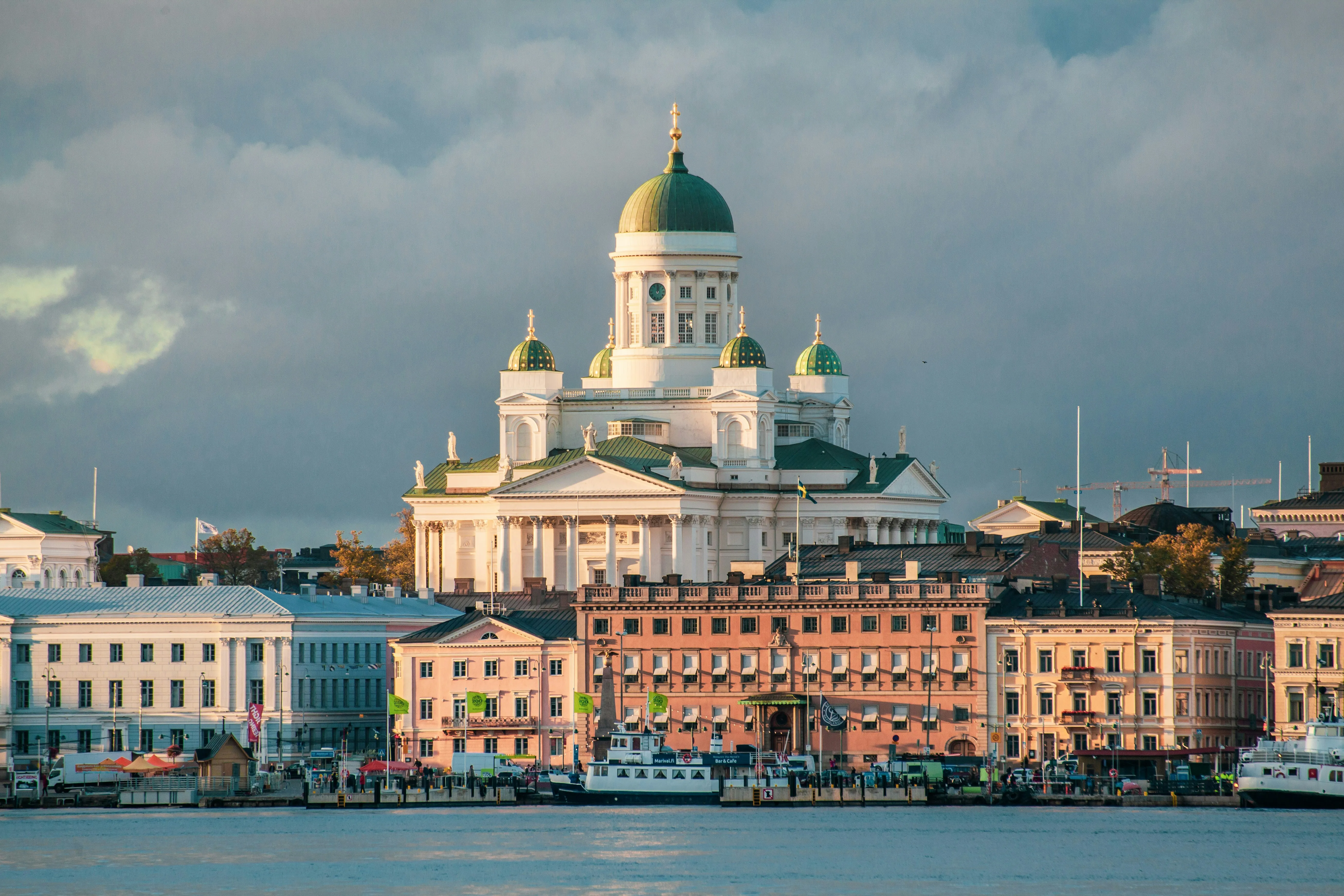
Finland presents itself as a destination of contrasts where urban modernity lives in harmony with extensive and little-altered nature. The capital, Helsinki, is the usual starting point and stands out for its functionalist and neoclassical architecture. Walking through Senate Square allows you to admire the silhouette of Helsinki Cathedral, while near the port is the Market Square, an ideal place to observe the city’s daily bustle and try local products. For those seeking cultural immersion, museums like the Ateneum, with its collection of classical Finnish art, or the avant-garde Amos Rex, offer a deep insight into the country’s identity.
To the north lies the region of Lapland, a territory marked by the light cycles of the Arctic. In its capital, Rovaniemi, it is possible to cross the Arctic Circle line and learn more about Sami culture and northern traditions. This area is especially known for its snowy landscapes in winter, where dog sledding excursions or snowshoe hikes take place, and for the phenomenon of the northern lights. During the summer, the environment is completely transformed under the midnight sun, allowing outdoor activities twenty-four hours a day in its numerous national parks, such as Pallas-Yllästunturi.
In the central and eastern part of the country, the Lake District predominates, a labyrinth of water and forests that defines much of the Finnish landscape. Lake Saimaa is the largest of all, and on its shores sit towns with great historical charm. One of the most prominent visits in this area is the city of Savonlinna, which houses Olavinlinna Castle, a medieval fortress situated on an islet that every year becomes the setting for important cultural festivals. This region is the favorite place to experience life in wooden cabins and the tradition of the sauna, fundamental elements of everyday well-being in Finland.
Moving towards the southwest coast, we find Turku, the oldest city in the country. Its historical heritage is concentrated around the Aura River, where the Turku Cathedral and the imposing Turku Castle, dating from the 13th century, are located. From here, you can explore the Turku Archipelago, a set of thousands of islands and islets connected by bridges and ferries offering cycling routes and trails among unique coastal landscapes. The tranquility of these islands contrasts with the dynamic and university atmosphere of the city.
Finally, the traveler should not overlook the small wooden coastal towns that preserve their medieval layout and traditional architecture. Porvoo, located a short distance from the capital, is famous for its red-colored warehouses on the riverbank and its cobbled streets. Similarly, the old town of Rauma, recognized for the preservation of its wooden urban fabric, offers a historical tour of commercial and seafaring life from past centuries. These rural and coastal areas show a more measured and traditional facet, ideal for understanding the geographical and cultural diversity that characterizes the entire territory.
Tip: You cannot miss a visit to Suomenlinna, the country’s most iconic site.
✈️ Best Time to Travel
Choosing the right time to visit Finland depends largely on the experiences you wish to have, as the country undergoes profound transformations with each change of season. While months of constant light allow for a vibrant and active nature, periods of snow and darkness offer a unique perspective on Arctic life and its deep-rooted traditions.
The climate varies significantly from south to north, but in general terms, the country’s infrastructure is adapted to all weather conditions. This makes it easier for travelers to focus on the contrasts of the landscape, which transitions from archipelagos and thousands of lakes during summer to the serenity of boreal forests covered in white during the rest of the year.
| Season | Months | Typical climate | What to expect | Tourist influx |
|---|---|---|---|---|
| Spring | Mar – May | Cool temperatures gradually rising; thaw and longer days. | Migratory bird watching, snow activities in the north, and the awakening of flora in the south. | Medium (⭐⭐) |
| Summer | Jun – Aug | Mild and pleasant (15-25 °C); midnight sun phenomenon in the north. | Outdoor life, sailing on lakes, cultural festivals, and hiking routes. | High (⭐⭐⭐) |
| Autumn | Sep – Nov | Temperature drop and increased rainfall; progressively shorter days. | The “Ruska” phenomenon (colorful foliage), wild berry picking, and the start of the northern lights. | Low (⭐) |
| Winter | Dic – Feb | Intense cold and snow throughout the country; few hours of light (polar nights). | Winter sports, sauna culture, snowy landscapes, and a traditional festive atmosphere. | High (⭐⭐⭐) |
🗣️ Basic Vocabulary
Although in Finland most of the population communicates fluently in English, especially in urban and tourist areas, knowing some basic words in Finnish is very useful for day-to-day life. Learning these expressions facilitates interactions in shops, restaurants, or transport, and is usually a gesture very well received by local inhabitants.
It is not necessary to delve into the complex grammar of the language to manage during the trip. By memorizing a few terms of courtesy and frequent greetings, you will be able to move with greater confidence and resolve everyday situations simply and directly.
- Hei: Hello.
- Kiitos: Thank you.
- Ole hyvä: You’re welcome / Here you go (used in both contexts).
- Anteeksi: Sorry / Excuse me.
- Kyllä: Yes.
- Ei: No.
- Moi: Hi (informal form, very common throughout the country).
- Puhutteko englantia?: Do you speak English?